
Is Polished Concrete the Right Floor for Your Northern Colorado Home or Business?
Polished concrete has been the flooring of choice in upscale retail stores, restaurants, and commercial spaces for years. More recently, Northern Colorado homeowners have started asking about it for their own spaces — basement renovations, garage upgrades, kitchen remodels, and home gym builds where the clean, modern look fits perfectly and the low-maintenance reality is genuinely appealing.
If you’ve been seeing polished concrete floors online and wondering whether it’s something you can realistically do in your home or business, this article covers what you need to know — what polished concrete actually is, where it works best, how it compares to epoxy, and what the process looks like when you hire a professional to do it right.
What Polished Concrete Actually Is
There’s a common misconception that polished concrete is a coating applied on top of your existing floor — like a very shiny sealant or a wax finish. It’s not. Polished concrete is the concrete itself, mechanically refined through a multi-stage grinding and polishing process using progressively finer diamond abrasives until the surface achieves the desired level of smoothness and reflectivity.
Think of it like finishing wood. You start with coarse sandpaper to flatten and shape the surface, work through progressively finer grits, and end up with something that’s smooth, sealed, and ready to take a finish. Polished concrete follows the same logic — except the raw material is your existing slab, and the “finish” is the concrete itself, brought to a level of clarity and sheen that bare concrete never achieves.
A chemical densifier is applied during the process to harden the concrete’s surface and close its pores, which improves both the final polish quality and the floor’s long-term durability and stain resistance.
The result is a floor whose finish is integral to the concrete — not sitting on top of it. There’s nothing to peel, nothing to delaminate, and nothing to recoat on a schedule.
The Range of Finishes Available
One reason polished concrete works in such a variety of settings is the range of finish levels available. You’re not locked into the showroom-mirror look if that’s not right for your space.
Matte/Flat — Minimal reflectivity. The concrete is refined and sealed but the surface reads as clean and natural rather than shiny. Works well in industrial-contemporary spaces, workshops, and anywhere you want a refined floor without a glossy aesthetic.
Satin/Low Gloss — A subtle sheen that gives the floor depth and dimension without being overtly reflective. One of the most popular choices for residential applications — polished enough to look intentional, understated enough to complement rather than dominate the room.
Semi-Gloss — Meaningful reflectivity that brightens a space noticeably. A good choice for commercial settings and larger residential spaces where you want the floor to contribute to the feel of the room.
High Gloss — The full mirror finish. Maximum reflectivity, deep clarity, and real visual impact. Common in automotive showrooms, upscale retail, and residential spaces where the floor is meant to be a statement.
The right finish level for your space depends on how you use it, the other design elements present, and personal preference. During an estimate visit, we walk through the options and help you identify what’s going to look right long-term — not just in the photos.
Where Polished Concrete Works Best in Northern Colorado Homes
Garages
A polished concrete garage floor gives the space the look of a high-end showroom without the busy pattern of a flake epoxy system. For car enthusiasts or homeowners who use the garage as a functional, finished extension of the home, a high-gloss polished floor paired with custom storage and good lighting is one of the most compelling transformations we do.
Polished concrete is also an excellent foundation for a garage that pulls double duty — as both a workspace and a gym, for example. It handles rubber mats, equipment, and heavy foot traffic without complaint.
Basements and Recreation Rooms
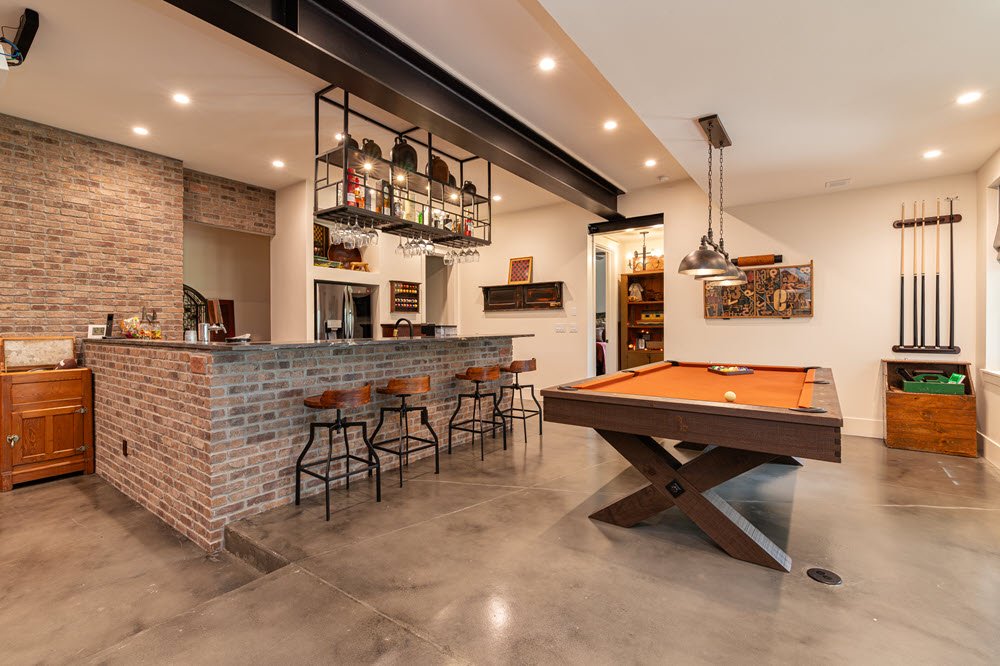
Polished concrete is one of the best flooring solutions for finished basements in Northern Colorado. It creates a seamless surface that works with virtually any design direction and eliminates the grout lines and seams that collect dirt in tile installations. Unlike hardwood or laminate, it holds up well under the temperature swings and dry conditions common to the region.
Kitchens and Living Areas
Polished concrete in residential living spaces isn’t as unusual as it might sound. In open-plan homes with a modern, industrial, or contemporary aesthetic, a concrete floor creates a cohesive, seamless surface that connects spaces naturally. It pairs well with exposed wood, steel accents, and large windows. The thermal mass of concrete also helps regulate temperature — a genuine advantage in Colorado’s climate where indoor comfort across seasons matters.
Commercial Spaces
Restaurants, retail stores, breweries, offices, showrooms — polished concrete handles heavy foot traffic better than most flooring options, communicates a quality aesthetic, and requires virtually no ongoing maintenance beyond routine cleaning. For Northern Colorado businesses investing in their physical space, it’s a floor that pays for itself over time compared to tile or carpet that needs replacing.
Home Gyms
Clean, sealed, easy to maintain, and visually sharp. Polished concrete in a home gym area — particularly combined with rubber flooring sections in the lifting zone — creates a professional feel that motivates you to actually use the space.
How Polished Concrete Compares to Epoxy
This is the question we hear most often from Northern Colorado homeowners who are weighing their flooring options. Both are excellent. They’re different tools for different goals.
Choose polished concrete when:
- You want a timeless, natural look that doesn’t read as a garage floor product
- Long-term permanence is the priority — nothing to recoat, ever
- The space is residential living area, commercial, or high-foot-traffic
- You prefer a seamless, minimal aesthetic over decorative color and pattern
- The floor will be in a space where you entertain or spend significant time
Choose epoxy or polyaspartic when:
- You want decorative color and the texture of a flake broadcast system
- Chemical resistance and hot tire pickup protection are priorities
- Slip resistance from the flake texture is important
- Budget is a primary consideration
- The space is a functional garage or utility area
Many of our larger projects combine both — polished concrete in finished interior areas, epoxy or polyaspartic in the working garage zone — creating a complete flooring system where each product is doing the job it’s best suited for.
Not sure which is right for your space? That’s exactly what the estimate visit is for. We assess the concrete, understand how you use the space, and give you an honest recommendation.
The Installation Process
Polished concrete is a professional job. The equipment — industrial diamond grinders and polishers — is not available for consumer rental in any meaningful configuration, and the process requires experience to execute correctly. Skipping stages, using wrong tooling, or rushing the densifier application produces an inferior finish that lacks both the depth and the durability of a properly polished floor.
Here’s what the process looks like when we do it:
Assessment and preparation. We evaluate the existing concrete — its condition, hardness, aggregate exposure, and any existing coatings or contamination. This determines the starting grit and the specific process path for that slab.
Coarse grinding. Industrial diamond tooling removes any existing coatings, flattens high spots, and establishes the surface profile that subsequent stages will refine.
Progressive refinement. We work through a sequence of progressively finer grits, each stage refining the scratch pattern left by the previous one. This is where the clarity and depth of the finished floor is built.
Densifier application. A penetrating chemical densifier is applied at the appropriate stage and worked into the surface. This hardens the concrete, reduces porosity, and improves both the final polish quality and the floor’s long-term stain resistance.
Final polishing. The last stages bring the surface to the specified sheen level — whether that’s a flat matte or a full high-gloss finish.
Sealer application. A penetrating sealer is applied to the finished surface for ongoing stain protection and to maintain the finish across Northern Colorado’s seasonal weather cycles.
Most residential polished concrete projects are completed in one to two days depending on the square footage and the condition of the existing concrete.
Maintaining a Polished Concrete Floor
This is where polished concrete genuinely earns its keep. Maintenance is as straightforward as flooring gets.
Regular cleaning is a dust mop or a damp mop with a pH-neutral cleaner. That’s it for routine care. Spills wipe up cleanly from the sealed surface. The floor doesn’t harbor dust or allergens the way carpet does. It doesn’t show wear patterns the way vinyl or wood can. And in commercial settings with heavy foot traffic, properly maintained polished concrete actually becomes more refined over time — the surface builds a patina rather than deteriorating.
There’s no waxing schedule. No recurring sealer application in most cases. No stripping and recoating. For a floor in a space you use heavily, that’s a significant practical advantage over most alternatives.
Ready to Talk About Your Floor?
PRO Garage Renovations installs polished and stained concrete floors for homeowners and businesses throughout Northern Colorado.
If you have concrete — in a garage, basement, kitchen, commercial space, or anywhere else — we can assess it, walk you through your finish options, and give you a free estimate. Most estimate visits take less than 30 minutes and come with no obligation to move forward.
📞 (720) 296-2710 ✉️ sales@pgrnorco.com
Get a Free Estimate → View Our Polished Concrete Gallery → Learn More About Our Flooring Services →
PRO Garage Renovations is locally owned and operated in Northern Colorado. We serve residential and commercial clients across the greater Northern Colorado area.